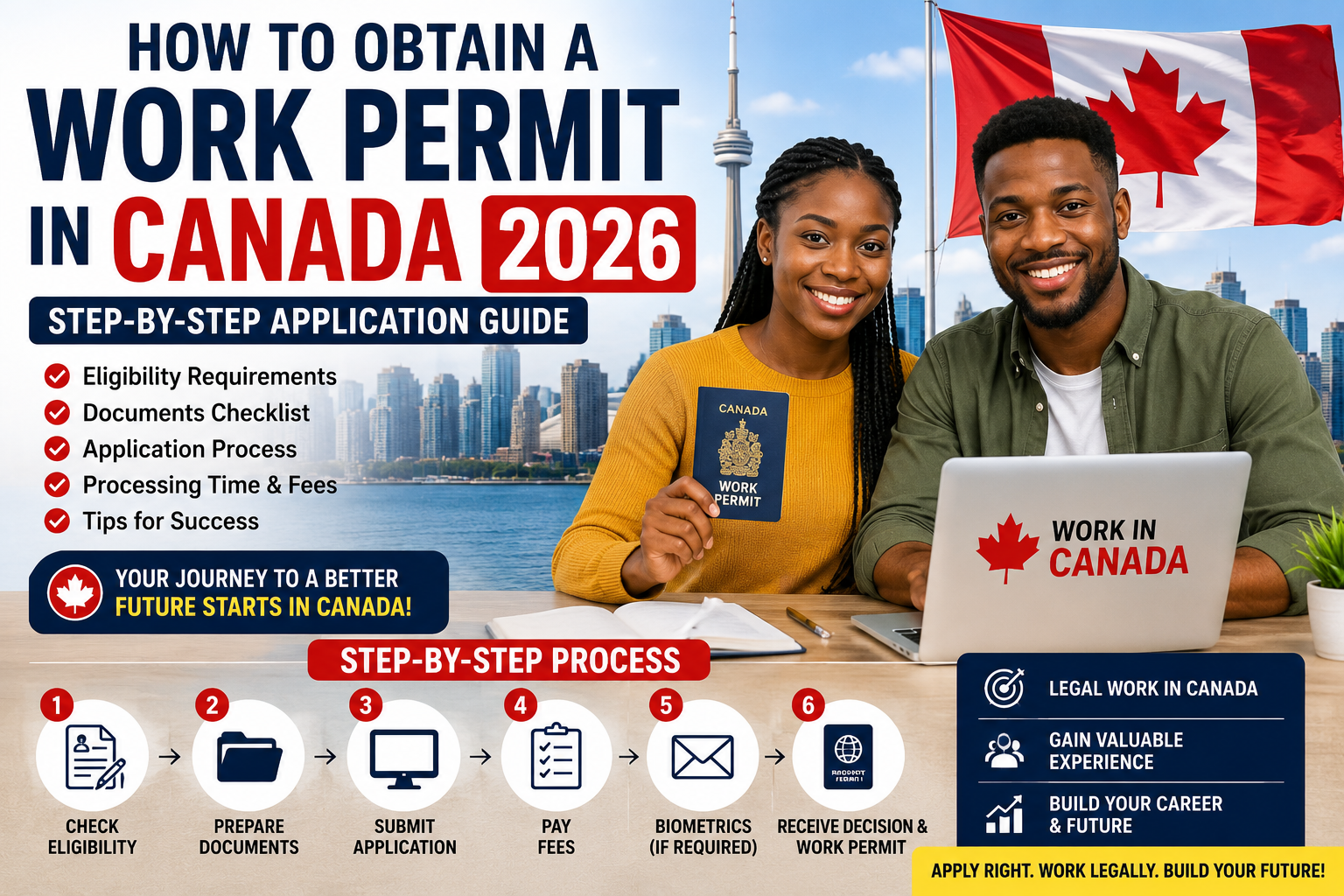
Learn how to obtain a work permit in Canada 2026 — types, fees, eligibility, documents, and a step-by-step online application guide for international workers.
Advertisements
Introduction: Is a Canadian Work Permit Within Your Reach?
Over one million temporary work permits are active in Canada at any given time — and thousands more are approved every month through Immigration, Refugees and Citizenship Canada (IRCC). If you’ve been wondering whether how to obtain a work permit in Canada 2026 is a realistic question for someone in your situation, the short answer is: yes, for millions of international workers, it absolutely is.
Canada continues to face significant labor shortages across technology, healthcare, skilled trades, hospitality, and agriculture. The federal government’s response has been to keep its work permit pathways robust and accessible for qualified foreign nationals who can fill those gaps.
But navigating the Canadian work permit system is not always straightforward. The rules changed meaningfully in 2024 and remain in effect in 2026, with tighter LMIA criteria, new employer caps, and updated processing timelines.
In this complete guide, you’ll learn:
Which type of work permit matches your situation
Exactly who qualifies and what documents you need
A step-by-step application walkthrough
Fees, processing times, and what to expect at the border
The most common mistakes that lead to refusals
Let’s get into it.
Types of Canadian Work Permits: Which One Applies to You?
Before anything else, you need to understand which category of work permit fits your circumstances. Choosing the wrong type is one of the most common — and costly — mistakes international workers make.
Employer-Specific (Closed) Work Permit
An employer-specific work permit is tied to a single employer, job, and location. The conditions on the permit specify who you work for, where you work, and for how long. This is the most common type for internationally recruited workers.
You need this type if:
You have a specific Canadian job offer that required an LMIA (Labour Market Impact Assessment)
You are being transferred within a multinational company (L-1 equivalent)
You are applying under specific caregiver or specialty programs
The key trade-off: if you want to change employers or roles, you generally need to apply for a new work permit before starting with the new employer.
Open Work Permit
An open work permit allows you to work for virtually any compliant Canadian employer without being tied to a specific job offer. However, IRCC issues open work permits only in specific circumstances.
You may qualify for an open work permit if:
You are the spouse or common-law partner of a skilled foreign worker or international student in Canada
You have graduated from a Canadian post-secondary institution and qualify for a Post-Graduation Work Permit (PGWP)
You have applied for permanent residence and qualify for a Bridging Open Work Permit (BoWP)
You are a refugee claimant or protected person
You hold International Experience Canada (IEC) eligibility (Working Holiday, Young Professionals, or International Co-op)
Open work permits cost more — CAD $255 total ($155 base fee + $100 open work permit holder fee) versus CAD $155 for a closed permit. But they offer far more flexibility, which is often worth it.
Key Differences at a Glance
Feature
Employer-Specific (Closed)
Open Work Permit
Job offer required?
Yes (usually with LMIA)
No (in most categories)
Can change employers?
No — new permit needed
Yes — any compliant employer
LMIA required?
Usually yes (TFWP route)
No
Government fee
CAD $155
CAD $255
Who qualifies?
Most internationally hired workers
Spouses, graduates, PR applicants, IEC
Processing time (2026)
8–30 weeks (total with LMIA)
4–12 weeks
Work Permit Eligibility for International Workers in Canada
Not everyone can apply for a Canadian work permit, regardless of which type. Here are the eligibility requirements that apply across the board.
General Eligibility Requirements
To be eligible to work and live in Canada legally on a work permit, you must generally:
Prove you will leave Canada when your permit expires (unless you apply for an extension or permanent residence)
Show you have no criminal record — certain criminal convictions may make you inadmissible
Be in good health — some applications require a medical exam (particularly for work in healthcare, childcare, or if you’ve lived in a country with high rates of certain diseases)
Have enough money to support yourself and your family during your stay and to return home
Not be on a list of people barred from Canada
Additional Requirements Depending on Your Stream
For TFWP-based (LMIA) work permits, your employer must have:
Received a positive LMIA from Employment and Social Development Canada (ESDC)
Offered you a job that meets or exceeds the prevailing wage for your occupation and province
Demonstrated that no qualified Canadian could fill the role
For IMP (International Mobility Program) permits (LMIA-exempt), you must fit into an eligible category such as intracompany transferees, significant benefit workers, or CUSMA/USMCA professionals.
For PGWP, you must have completed a full-time program of at least 8 months at a Designated Learning Institution (DLI) in Canada.
2026 important update: Since 2024, LMIA applications under the Temporary Foreign Worker Program are being reviewed using stricter criteria. Two factors now play a central role: the offered wage must match regional standards for the occupation, and the work location can trigger additional restrictions, as certain regions of Canada are subject to limitations. Plan ahead with your employer accordingly.
Documents You’ll Need to Apply for a Work Permit in Canada
Document preparation is where many applicants lose time. Getting this right before you start your application prevents delays and avoids costly refusals.
Your specific document checklist is generated when you complete IRCC’s eligibility questionnaire (more on that in the step-by-step section below), but here are the core documents required for most applications:
Identity and Travel Documents
Valid passport (must be valid for the duration of your intended stay — ideally 6+ months beyond your permit end date)
Copies of any previous Canadian visas or permits (if applicable)
Two passport-sized photos meeting IRCC specifications
Job Offer and Employer Documents
Written job offer letter from your Canadian employer, including role, wages, location, and duration
Positive LMIA letter from ESDC (if your job requires one) with the LMIA number
For LMIA-exempt positions: the offer of employment number generated through the IRCC Employer Portal
Supporting Documents
Educational credentials, diplomas, or professional certifications relevant to your role
Work experience letters or employment records supporting your qualifications
Police clearance certificate from your current country of residence (and any country where you have lived for 6+ months in the past 10 years)
Medical examination results (if required — check IRCC’s medical exam requirements for your nationality)
Biometrics — fingerprints and photo (most applicants aged 14–79 must provide biometrics unless they’ve submitted within the past 10 years; fee: CAD $85)
How to Obtain a Work Permit in Canada 2026: Step-by-Step
Now for the core of this guide. Here is the complete, step-by-step process to apply for a Canada work permit online in 2026.
Step 1: Confirm Your Eligibility and Permit Type
Start at canada.ca and use IRCC’s online eligibility tool to determine which type of work permit you qualify for. This tool asks questions about your nationality, job situation, employer, and whether an LMIA is required.
Getting this right at the start saves you from submitting the wrong application — which IRCC cannot always redirect and may require a full resubmission.
Step 2: Secure Your Job Offer and Confirm Employer Steps (If Required)
If you’re applying under the TFWP (employer-specific, LMIA required), your employer must complete their obligations before you can submit your application:
Employer advertises the position to Canadian residents and documents that no qualified Canadians are available
Employer submits an LMIA application to ESDC and pays the $1,000 CAD LMIA processing fee (the employer pays this — it is illegal for them to pass this cost to you)
ESDC processes the LMIA — standard processing takes approximately 8–29 business days for most streams, though it can stretch to several months for regular applications during peak periods
Employer shares the positive LMIA number with you once approved
For IMP (LMIA-exempt) positions, your employer submits an offer of employment through the IRCC Employer Portal and pays a CAD $230 employer compliance fee. They then share the offer of employment number with you — this replaces the LMIA in your application.
Tip: The Global Talent Stream within TFWP offers accelerated LMIA processing of approximately two weeks for qualifying high-skilled tech positions, provided employers meet wage requirements and commit to a Labour Market Benefits Plan.
Step 3: Gather All Required Documents
Using the checklist from Step 1 (and refined by IRCC’s questionnaire in Step 4), collect and organize all your documents. Scan everything clearly — blurry or incomplete scans are a leading cause of processing delays.
Key items to prepare at this stage:
Valid passport
LMIA number or IMP offer of employment number
Job offer letter
Educational credentials
Police clearance certificate(s)
Medical exam results (if required)
Step 4: Create or Sign In to Your IRCC Secure Account
Go to canada.ca and sign in to your IRCC Secure Account (or create one if you don’t have one). This is the platform through which all Canadian immigration applications are submitted online.
Once logged in, complete the eligibility questionnaire. Your answers generate a personalized document checklist — the specific forms and supporting materials IRCC requires for your exact situation. Read the instruction guide carefully before completing any forms; it explains each field and what is expected.
Step 5: Complete the Online Application Forms
Complete the online forms within your IRCC Secure Account. The primary form for most work permit applications is IMM 1295. Key rules for completing the application accurately:
Answer all questions truthfully and completely — false or incomplete information can result in a refusal and future inadmissibility to Canada
Fill out all mandatory fields before submitting (you cannot submit with blank required fields)
Do not leave gaps in your work or education history — include all absences, unemployment periods, and travel dates
Include all paid and unpaid work in your work history section
You can save and return to your application as often as needed until you are ready to submit
Step 6: Pay the Application Fees
Pay the required government fees through your IRCC Secure Account. Here is the full 2026 fee breakdown:
Fee Type
Amount (CAD)
Who Pays
Work permit processing fee
$155
Applicant
Open work permit holder fee (if applicable)
$100
Applicant
Biometrics fee
$85
Applicant
LMIA processing fee
$1,000
Employer only
Employer compliance fee (IMP)
$230
Employer only
VAC service fee (varies by country)
~$40–$50
Applicant
Medical exam (if required)
~$200–$300
Applicant
Total out-of-pocket for most applicants: CAD $240–$340 (not including medical or translation costs). LMIA-exempt applicants from visa-exempt countries can spend as little as CAD $200 in total.
Step 7: Submit Your Application and Provide Biometrics
Submit your completed application through your IRCC Secure Account. After submission, IRCC may request that you provide biometrics (fingerprints and photo) at a designated Visa Application Centre (VAC) or Application Support Centre near you. Schedule and complete this promptly — delays in biometric submission can significantly slow processing.
Don’t wait until the last day to submit. IRCC’s system runs on UTC time, and the difference between your local time and UTC could make you miss a deadline.
After submitting, monitor your IRCC Secure Account regularly for any requests for additional documents, medical exam notifications, or status updates.
Step 8: Wait for a Decision and Receive Your Permit
In 2026, work permit processing times vary significantly by stream:
Closed work permits with LMIA: 8–30 weeks total (LMIA + work permit)
Open work permits: 4–12 weeks
Post-Graduation Work Permits (PGWP): 8–12 weeks
Global Talent Stream (high-skilled tech): approximately 2 weeks
Intracompany transferees: 4–8 weeks
Once approved, the process differs depending on where you applied from:
Applied from outside Canada: You receive a Port of Entry Letter of Introduction (not the physical permit itself). Present this to a Canada Border Services Agency (CBSA) officer when you arrive at a Canadian port of entry — the officer issues your physical work permit after verifying your identity.
Applied from inside Canada: Your physical work permit arrives by mail to your Canadian address.
Step 9: Arrive in Canada and Begin Working
When you arrive at the border, present your Letter of Introduction and valid passport to the CBSA officer. They will review your documents, confirm your admissibility, and issue your work permit stamp or document on the spot. You can then travel to your work location and begin employment with your sponsoring employer.
Canadian Immigration Pathways 2026: From Work Permit to Permanent Residency
A Canadian work permit is often more than just authorization to work — for many people, it’s the first step on the path to permanent residency. Here’s how the most relevant Canadian immigration pathways 2026 connect:
Canadian Experience Class (CEC) — Express Entry
After working in Canada for at least 12 months in a skilled occupation under a valid work permit, you may qualify for the Canadian Experience Class under Express Entry. As of May 2026, standard Express Entry applications average approximately 7 months from submission to PR approval.
Provincial Nominee Programs (PNP)
Many provinces run streams specifically targeting workers already employed in the province. If you hold a work permit in a province and your employer supports your nomination, a PNP pathway can accelerate your permanent residency timeline significantly. Base PNP applications are currently taking approximately 13 months to process as of 2026.
Atlantic Immigration Program (AIP)
For workers employed by designated employers in Atlantic Canada (New Brunswick, Nova Scotia, Prince Edward Island, Newfoundland and Labrador), the AIP offers an LMIA-exempt pathway that leads directly to permanent residence.
Bridging Open Work Permit (BoWP)
If you apply for permanent residence before your current work permit expires, you may qualify for a Bridging Open Work Permit (BoWP), which allows you to continue working (for any employer) while your PR application is being processed.
Conclusion: Your Canadian Work Permit Journey Starts Today
The process of how to obtain a work permit in Canada 2026 is multi-layered — but it is absolutely achievable for millions of international workers every year. With the right permit type, the right employer, and careful document preparation, you can build a legal, stable working life in one of the world’s most welcoming countries.
Here’s what to carry forward from this guide:
Know your permit type: Employer-specific (closed) if you have a sponsored job offer with LMIA; open if you qualify through graduation, spousal status, IEC, or PR application
Understand the LMIA: Your employer handles this step — it costs them $1,000 and takes weeks; you cannot shortcut it
Apply online through IRCC: Create your Secure Account, complete the questionnaire, and let the system generate your personalized checklist
Budget correctly: CAD $240–$340 for most applicants, plus potential medical and translation costs
Plan for the timeline: 4–30 weeks depending on your stream — apply early and have all documents ready before you start
Think long-term: Your work permit can be the foundation for permanent residency through Express Entry, PNP, or the Atlantic Immigration Program
Canada’s doors are open for qualified international workers in 2026. The system rewards preparation, honesty, and patience.
Start your eligibility check on canada.ca today — and drop your questions or experiences in the comments below. Your journey could be exactly the inspiration someone else needs to take that first step!
Frequently Asked Questions (FAQ)
1. How long does it take to obtain a work permit in Canada in 2026?
Processing times in 2026 vary significantly by permit type and stream. Open work permits process in 4–12 weeks from application submission. Employer-specific (closed) work permits that require an LMIA can take 8–30 weeks total, factoring in both LMIA processing and IRCC’s work permit decision. The Global Talent Stream for high-skilled tech positions offers roughly two-week LMIA processing. Post-Graduation Work Permits process in 8–12 weeks. These timelines do not include time for gathering documents, employer steps, or biometrics — always factor in additional lead time when planning your move.
2. Can I apply for a Canada work permit without a job offer?
Yes, in some circumstances. Open work permit categories — including the International Experience Canada (IEC) Working Holiday program, Post-Graduation Work Permits (PGWP), and spousal/partner open work permits — do not require a job offer. However, for the most common pathways (TFWP/LMIA-based employer-specific permits), a valid job offer from a Canadian employer is a prerequisite. Knowing which category you qualify for is the essential first step before applying.
3. How much does a Canada work permit cost in 2026?
The government processing fee is CAD $155 for most employer-specific work permits and CAD $255 for open work permits (the additional $100 is the open work permit holder fee). Most applicants also pay a CAD $85 biometrics fee unless they submitted biometrics within the past 10 years. Medical exams, if required, cost approximately $200–$300. Visa Application Centre service fees vary by country (around CAD $40–50 in many locations). The LMIA fee of CAD $1,000 is paid by the employer, not the applicant — and it is illegal under Canadian federal regulations for employers to recover this cost from workers.
4. What is an LMIA and do I need one for my Canadian work permit?
A Labour Market Impact Assessment (LMIA) is a document from Employment and Social Development Canada (ESDC) that confirms a Canadian employer could not find a qualified Canadian citizen or permanent resident to fill a specific job — and therefore has permission to hire a foreign worker. Your employer applies for and pays for the LMIA, not you. Many work permits require a positive LMIA under the Temporary Foreign Worker Program. However, a significant number of positions are LMIA-exempt under the International Mobility Program — these include intracompany transfers, significant benefit positions, and roles covered by international trade agreements like CUSMA (formerly NAFTA).
5. Can I change jobs while on a Canadian work permit?
It depends on the type of permit you hold. If you hold an open work permit, you can work for virtually any compliant employer in Canada and change jobs without applying for a new permit. If you hold an employer-specific (closed) work permit, you are legally authorized to work only for the employer named on your permit. Working for a different employer without authorization violates your permit conditions and can jeopardize future immigration applications. To change employers on a closed work permit, your new employer typically needs to complete their LMIA or IMP employer portal steps, and you must apply for a new work permit before starting with them.
6. Does a Canadian work permit lead to permanent residency?
A work permit itself does not grant permanent residency, but it is often the most practical first step toward it. After working in Canada for 12 months or more in a qualifying skilled occupation, you may become eligible for the Canadian Experience Class (CEC) under Express Entry — Canada’s primary pathway to economic permanent residence. Provincial Nominee Programs also target experienced workers in specific provinces. The Atlantic Immigration Program offers direct PR pathways for workers with designated Atlantic Canada employers. Many international workers strategically pursue a work permit knowing their Canadian work experience will substantially strengthen a future PR application.