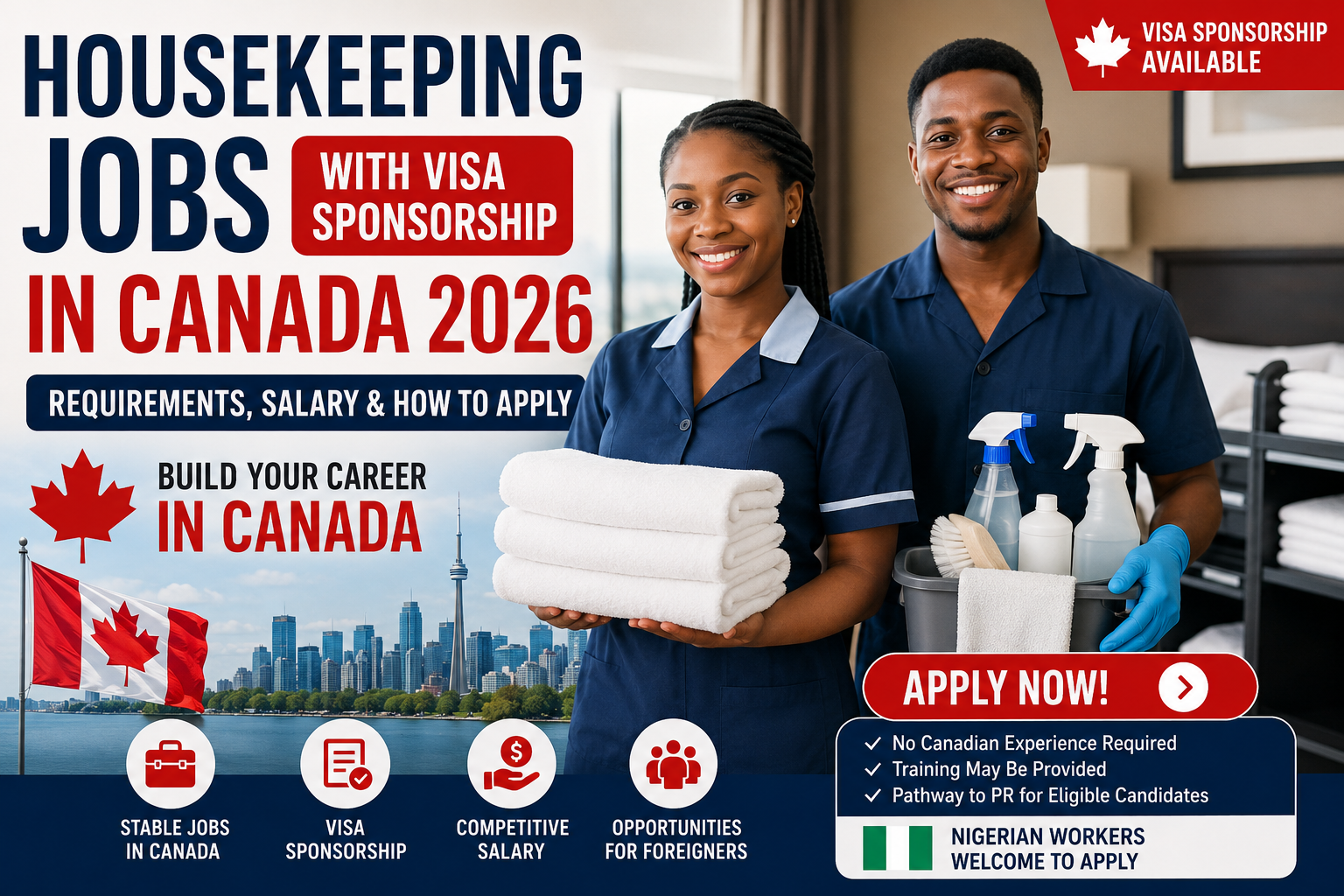
Explore housekeeping jobs with visa sponsorship in Canada 2026 — salary ranges, LMIA process, top provinces, requirements, and a step-by-step guide to apply successfully.
Introduction: Could a Housekeeping Job Be Your Gateway to Canada?
Canada’s hospitality and service sector is facing a staffing crisis — and it’s creating real, legal opportunities for foreign workers who are ready to step in. From luxury hotels in British Columbia’s Canadian Rockies to busy urban hotels in Toronto and Alberta, housekeeping jobs with visa sponsorship in Canada 2026 are available for motivated international applicants willing to work hard and follow the right process.
The Government of Canada’s Job Bank rates the employment outlook for hotel room attendants and light duty cleaners as “good to very good” across most provinces. And with Canada’s tourism sector continuing to grow and its aging population requiring more care facility staff, that demand shows no signs of cooling.
In this guide, you’ll discover:
- Which types of housekeeping roles qualify for visa sponsorship in Canada
- Salary expectations across different provinces in 2026
- The LMIA and TFWP visa pathways explained clearly
- Which provinces and employers are actively hiring foreign housekeepers
- A step-by-step application guide that actually works
Let’s get started.
Why Canada Needs Foreign Housekeepers in 2026
Canada simply does not have enough domestic workers to fill its housekeeping and cleaning vacancies. This isn’t a temporary blip — it’s a structural labor shortage driven by several intersecting factors.
Tourism is one key driver. Canada welcomed record numbers of international visitors in recent years, and that growth has placed enormous pressure on the hospitality sector’s ability to staff hotels, resorts, and lodges. At the same time, Canada’s aging population is driving demand for cleaning and support staff in long-term care facilities and assisted living homes.
The result? Employers across British Columbia, Ontario, Alberta, and Quebec continue hiring through the Temporary Foreign Worker Program (TFWP) to fill critical housekeeping gaps. For international applicants, this means there is a legitimate, government-supported pathway to work in Canada as a housekeeper — provided you find the right employer and follow the correct process.
Types of Housekeeping Jobs in Canada for Foreigners
Before you start applying, it helps to understand the different roles that fall under the “housekeeping” umbrella in Canada. Each has slightly different requirements and work environments.
Hotel Room Attendant
This is the most commonly sponsored housekeeping role. Room attendants work in hotels, resorts, and motels, cleaning and preparing guest rooms between stays. Core duties include making beds, replacing linens and towels, sanitizing bathrooms, vacuuming, and restocking amenity supplies.
Where they’re hired: Hotels, resorts, and lodges across all provinces. Alberta’s Banff and Jasper resort corridors are particularly active.
Light Duty Cleaner
Light duty cleaners maintain cleanliness in commercial and institutional settings: offices, retail stores, healthcare clinics, and government buildings. This role is one of the most accessible for foreign workers because it often requires minimal formal education and employers can train on the job.
Where they’re hired: Offices, hospitals, schools, and commercial facilities across all major provinces.
Domestic Housekeeper
Domestic housekeepers work in private residences, providing cleaning, laundry, meal preparation support, and household organization for families or individuals. Live-in domestic positions are particularly common and can include accommodation as part of the compensation package.
Where they’re hired: Private households in major urban centers — Toronto, Vancouver, Calgary, Ottawa.
Housekeeping Supervisor / Team Lead
Supervisory housekeeping roles oversee a team of room attendants or cleaners and are responsible for scheduling, training, quality control, and liaising with management. These positions typically pay more and may have a faster path to permanent residency through provincial nominee programs.
Where they’re hired: Larger hotels, hospital systems, and cleaning companies with structured management hierarchies.
Environmental Services Worker (Healthcare)
Environmental services workers maintain cleanliness in hospitals, long-term care homes, and other healthcare facilities. These roles follow strict infection control and sanitation protocols and are in extremely high demand given Canada’s growing senior population.
Where they’re hired: Hospitals, nursing homes, and care facilities across every province.
Salary Guide: Housekeeping Jobs in Canada 2026
Wages for housekeeping roles in Canada vary significantly by province, employer type, and experience level. Here’s what you can realistically expect in 2026:
Hourly and Annual Wages by Role
| Role | Hourly Wage (CAD) | Annual Salary (CAD) | Notes |
|---|---|---|---|
| Hotel Room Attendant | $15.00 – $22.00 | $28,000 – $40,000 | Wage increases with seniority |
| Light Duty Cleaner | $17.00 – $23.00 | $30,000 – $42,000 | Higher in healthcare settings |
| Domestic Housekeeper | $15.00 – $25.00 | $28,000 – $45,000 | Live-in roles may include housing |
| Housekeeping Supervisor | $22.00 – $30.00 | $40,000 – $55,000+ | Management responsibilities |
| Environmental Services (Healthcare) | $18.00 – $26.00 | $33,000 – $48,000 | Often unionized with full benefits |
A full-time housekeeper working 40 hours per week can generally expect to earn between CAD $32,000 and $45,000 per year, with supervisors earning CAD $50,000 or more. Starting wages typically begin around CAD $20/hour and can increase to approximately CAD $25/hour with experience, particularly in resort and hospitality settings.
Additional Benefits That Matter
Many sponsored housekeeping positions include benefits beyond base salary. These make the total compensation package significantly more valuable:
- Housing assistance — Some employers, especially in remote resort areas, provide subsidized or free accommodation
- Meals — Resort and hotel employers often include staff meals
- Health and dental benefits — Particularly common in unionized healthcare and hotel positions
- Travel allowance — Some employers contribute to relocation costs
- LMIA fee coverage — Many employers sponsoring through TFWP cover the mandatory $1,000 CAD LMIA processing fee
- Overtime pay — Provincial labor laws require overtime rates for hours beyond 44/week in most provinces
Visa Pathways: How the Sponsorship Process Works in Canada
This is the section most applicants get confused about. Canada does not use a single “visa sponsorship” system the way some other countries do. Instead, there are two main legal frameworks that allow employers to hire foreign housekeepers.
Temporary Foreign Worker Program (TFWP) — The Primary Route
The TFWP is the most common pathway for housekeeping jobs in Canada for foreigners requiring direct employer sponsorship.
Here’s how it works:
- Employer identifies a vacancy they cannot fill with Canadian workers or permanent residents
- Employer applies for a Labour Market Impact Assessment (LMIA) from Employment and Social Development Canada (ESDC). This document formally confirms there is a genuine need for a foreign worker.
- ESDC approves the LMIA — the employer must demonstrate advertising efforts and prove no qualified Canadians are available
- Employer extends a job offer to the foreign worker, backed by the positive LMIA
- Foreign worker applies for a work permit using the LMIA number provided by the employer
- Work permit is approved — the worker can then travel to Canada and begin employment
The LMIA process is the critical step. Without an approved LMIA, the employer cannot legally sponsor a foreign worker under TFWP. Importantly, many employers offer to cover the $1,000 LMIA application fee as part of their international recruitment package — always confirm this upfront.
Important 2024 update still in effect for 2026: The Canadian federal government introduced a 10% employer cap on temporary foreign workers for positions included in the Low-wage Stream of the TFW Program — which includes light duty cleaners and laundry attendants. This means employers can have no more than 10% of their total workforce in these roles under TFWP. This cap affects hiring volumes but does not eliminate opportunities.
International Mobility Program (IMP) — LMIA-Exempt Routes
Some foreign workers can work in Canada without requiring an LMIA through the International Mobility Program. This includes:
- Open Work Permit holders (e.g., those in Canada on a post-graduation work permit or spousal work permit) — these workers can take any job, including housekeeping, without an employer-specific sponsorship
- Working Holiday / International Experience Canada (IEC) — citizens of eligible countries aged 18–35 can obtain an open work permit under IEC, making them attractive candidates for housekeeping employers who prefer not to navigate the LMIA process
If you’re from an IEC-eligible country, this is often the fastest route to landing a housekeeping job in Canada.
Best Provinces for Housekeeping Jobs in Canada for Foreigners
Not all provinces are equally active in hiring international housekeepers. Here’s where the most consistent opportunities exist:
Alberta
Alberta is one of the most active provinces for housekeeping jobs in Alberta Canada for foreigners, driven by the booming Rocky Mountain resort corridor (Banff, Jasper, Canmore) and its large hospitality and oil services industries. The province’s strong economy and relatively lower cost of living compared to Vancouver make it particularly attractive for newcomers.
CBC reporting confirms that Alberta employers saw dramatic increases in LMIA approvals in recent years, reflecting the province’s growing reliance on temporary foreign workers to fill service sector gaps.
British Columbia
BC’s tourism industry — centered on Vancouver, Whistler, and the Vancouver Island resort circuit — generates strong demand for hotel room attendants and resort housekeepers year-round. The province’s minimum wage is among Canada’s highest, which benefits entry-level workers.
Ontario
Canada’s most populous province offers the largest absolute number of housekeeping vacancies, particularly in the Greater Toronto Area’s hotel district and along the Niagara tourism corridor. Healthcare cleaning positions in Ontario’s hospital networks are also consistently available.
Quebec
Quebec’s hospitality sector in Montreal and its broader tourism industry generates steady housekeeping demand. Some employers in Quebec may prefer French-speaking applicants, though English is sufficient for many hotel and cleaning roles.
Prince Edward Island, New Brunswick & Nova Scotia
These Atlantic provinces are actively using immigration pathways to address labor shortages. The Atlantic Immigration Program (AIP) — which is LMIA-exempt — offers an alternative route for workers who receive offers from designated employers in these provinces. Several housekeeping employers in Atlantic Canada are AIP-designated.
Requirements for Housekeeping Jobs with Visa Sponsorship in Canada
The good news about unskilled jobs in Canada with visa sponsorship like housekeeping is that the entry bar is relatively accessible. Here’s what most employers and immigration authorities require:
Educational Requirements
- Minimum: High school graduation certificate or equivalent (for most roles)
- Many positions list “No degree or diploma required” — experience is prioritized over formal education
- Some roles accept candidates who will be trained on the job
Work Experience
- Most LMIA-sponsored positions require 1–2 years of relevant housekeeping or cleaning experience
- Experience in hotels, hospitals, care facilities, or domestic cleaning settings is most valued
- Some hotel and resort roles list “experience an asset” rather than mandatory — ideal for those with limited prior work history
Language Requirements
- English is required for communication in most provinces (French in Quebec)
- For many housekeeping positions in 2026, no formal IELTS score is required at the initial stage, provided you can communicate effectively for safety purposes
- Basic conversational English — enough to understand supervisor instructions and interact professionally with guests or residents — is generally sufficient
Personal Requirements
- Minimum age: 18 years old
- Clean criminal record background check (required for most positions, especially in healthcare and domestic settings)
- Physical fitness (housekeeping is physically demanding — standing for extended periods, lifting linens, bending, and moving equipment)
- Attention to detail and a reliable, professional work ethic
How to Apply for Housekeeping Jobs with Visa Sponsorship in Canada: Step-by-Step
Ready to take action? Here is the most practical path from where you are now to a sponsored housekeeping role in Canada.
Step 1: Find Employers Actively Sponsoring Foreign Workers
Not every Canadian employer is willing or able to navigate the LMIA process. Focus your search on employers who have done it before or are currently advertising with LMIA/TFWP explicitly mentioned.
Use these platforms:
- Job Bank Canada (jobbank.gc.ca) — Canada’s official government job portal. Filter by “LMIA-approved” jobs to find positions where the employer has already begun or completed the sponsorship process
- Indeed.ca — Search “housekeeping LMIA” or “housekeeping visa sponsorship Canada”
- Glassdoor.ca — Search for housekeeping roles and check job descriptions for LMIA or TFWP mentions
- Canada Career Site (canadacareersite.com) — Specifically lists LMIA housekeeping and hotel housekeeping jobs for temporary foreign workers
- LinkedIn — Many hotels and cleaning companies post LMIA-eligible roles on LinkedIn with international hiring notes
Step 2: Prepare a Strong Resume and Cover Letter
Canadian employers expect a clean, professional, and concise CV. Key tips:
- Keep it to one page for most housekeeping applications
- List your cleaning experience with specific settings (hotel, hospital, private home)
- Include any relevant certifications (WHMIS — Workplace Hazardous Materials Information System — is valued in Canada)
- Quantify your experience where possible (“Cleaned 18–22 guest rooms per shift”)
- Cover letter: Briefly state that you require a work permit and are open to the TFWP/LMIA process. Employers who are open to sponsoring will appreciate the transparency.
Step 3: Apply Early and Follow Up
Canadian hospitality employers — especially resorts in Alberta and BC — often recruit for summer and winter seasons months in advance. For summer 2026 roles, many employers began recruiting in early 2026. Apply as early as possible and follow up professionally one to two weeks after submitting your application.
Step 4: Attend the Interview (Remote or In-Person)
Most international interviews are conducted via video call. Prepare to discuss:
- Your previous cleaning or housekeeping experience in detail
- Your ability to meet physical demands of the role
- Your availability to relocate to Canada
- Any certifications or training you hold
- Your understanding of the work permit and LMIA process
Step 5: Receive and Accept the Job Offer
Once an employer decides to hire you, they will extend a formal job offer and initiate the LMIA application process. Your role at this stage is to:
- Provide all required documentation (passport, qualifications, references)
- Sign the job offer agreement
- Wait for the employer to receive their positive LMIA decision
Step 6: Apply for Your Work Permit
Once the employer has a positive LMIA, they will provide you with the LMIA number. You then apply to Immigration, Refugees and Citizenship Canada (IRCC) for an employer-specific work permit. You can apply online through the IRCC portal. Processing times vary by country of origin — plan for several months.
Step 7: Travel to Canada and Begin Work
Once your work permit is approved and you receive your visa stamp at the Canadian consulate, you can travel to Canada and begin your employment. Your work permit will be tied to that specific employer, role, and location — changes require an amendment.
Conclusion: Your Canadian Housekeeping Career Starts With the Right Move
Canada’s labor shortages are real, the demand for housekeepers is persistent, and the legal pathways for international workers are clear and well-established. Housekeeping jobs with visa sponsorship in Canada 2026 offer more than just a paycheck — they offer a foothold in one of the world’s most desirable countries to live and work.
Here’s your action summary:
- Know your role: Hotel room attendant, light duty cleaner, domestic housekeeper, or supervisor — each has different requirements and pathways
- Understand the LMIA process: The TFWP is the primary route; the employer initiates it, not you
- Target the right provinces: Alberta, British Columbia, Ontario, and Atlantic Canada are the most active for sponsored housekeeping roles
- Use the right platforms: Job Bank Canada, Indeed.ca, and Canada Career Site are your best starting points
- Apply early and be transparent about your need for work permit sponsorship
The path to Canada through housekeeping is accessible, legal, and well-traveled by thousands of international workers every year. With the right employer, the right province, and the right preparation, 2026 could be the year you make that move.
Start your job search today on Job Bank Canada — and share your journey or questions in the comments below. Your experience could be the inspiration someone else needs to take that first step!
Frequently Asked Questions (FAQ)
1. Can I get a housekeeping job in Canada as a foreigner without IELTS?
Yes, in many cases. For many housekeeping positions in 2026, no formal IELTS score is required at the initial stage, provided you can communicate effectively for safety purposes. Employers primarily want to know you can understand instructions, communicate with guests or supervisors, and work safely. However, basic conversational English (or French in Quebec) is essential. Some employers may ask for a basic language assessment, but this is typically much less demanding than an IELTS exam.
2. Who pays for the LMIA when a Canadian employer sponsors a foreign housekeeper?
The employer pays for the LMIA. The mandatory LMIA processing fee is $1,000 CAD, and this is the employer’s legal responsibility — it is illegal in Canada for an employer to pass this cost on to the foreign worker. Many employers sponsoring through TFWP cover this fee as part of their international recruitment costs. Be cautious of any employer or recruiter asking you to pay for the LMIA — that is a red flag for a scam.
3. How long does the LMIA sponsorship process take for housekeeping jobs in Canada?
Processing times vary depending on the stream and current ESDC workload. For low-wage TFWP positions (which includes most housekeeping roles), LMIA processing has historically taken 4 to 12 weeks from the employer’s application date. After the positive LMIA is issued, the foreign worker then applies for a work permit from IRCC, which can take an additional 4 to 20 weeks depending on the country of origin and visa office processing times. Total timeline from job offer to arrival in Canada is typically 4 to 9 months.
4. Which province has the most housekeeping jobs for foreigners in Canada?
Alberta, British Columbia, and Ontario are consistently the three most active provinces for sponsored housekeeping opportunities. Alberta’s Rocky Mountain resort corridor (Banff, Jasper) is especially active for hotel room attendant roles with LMIA sponsorship. British Columbia’s Whistler and Vancouver Island resort areas are similarly active. Ontario offers the most urban hotel and healthcare cleaning roles. Atlantic provinces are increasingly competitive through the LMIA-exempt Atlantic Immigration Program.
5. Can a housekeeping job lead to permanent residency in Canada?
Yes. While the initial work permit tied to a housekeeping role is temporary, Canadian work experience in eligible NOC categories can support a permanent residency application over time. Pathways include the Canadian Experience Class (CEC) under Express Entry (for workers who accumulate 1+ year of Canadian work experience), Provincial Nominee Programs (PNPs) that target workers with in-demand labor market skills, and the Agri-Food Pilot for some agricultural and food processing roles. Additionally, moving into a supervisory housekeeping role can place you in a higher NOC category, expanding your immigration options.
6. Is it possible to find hotel housekeeping jobs in Canada for foreigners that include free accommodation?
Yes, particularly in remote resort locations. Many hotels and resorts in Alberta’s Banff National Park area, BC’s Whistler corridor, and Ontario’s cottage country offer staff accommodation as part of the employment package — either free or heavily subsidized. This is one of the most attractive features of resort housekeeping jobs for international workers, as it significantly reduces living costs in areas where private rental housing is expensive or scarce. Always ask about accommodation availability when reviewing job listings in resort destinations.